
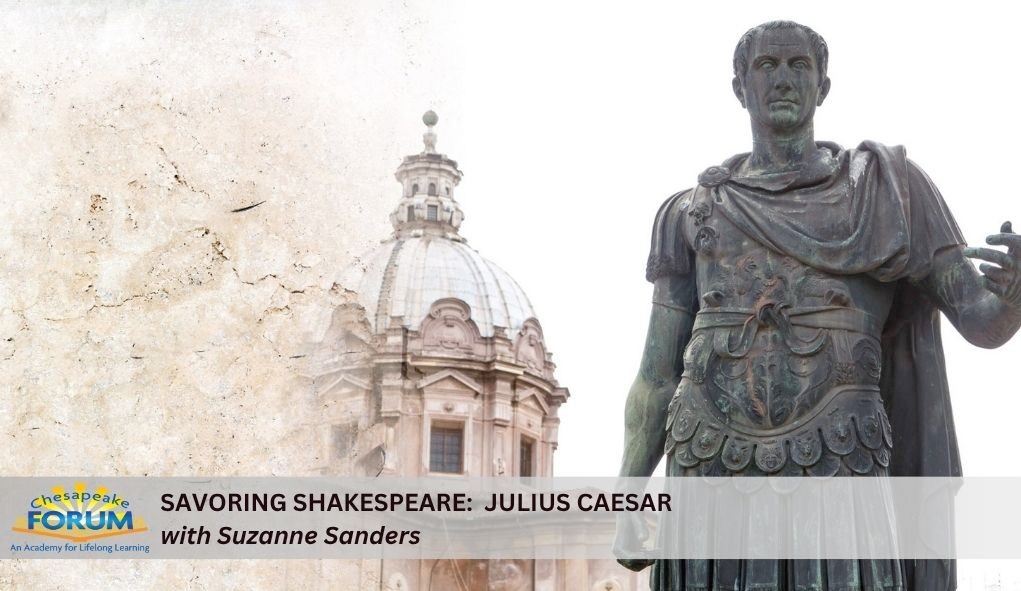
Dig in to Shakespeare’s Julius Caesar — conspiracy, revenge, and even John Wilkes Booth! How can ancient history feel so current?
The Savoring Shakespeare series explores Shakespeare’s works at a relaxed pace, the better to enjoy their delightful heights and plumb their powerful depths. We read the plays together, discussing plot, themes, and our feelings as we go along. No expertise is necessary — beginners are welcome.
Suzanne assists by giving definitions and highlighting key details, but the main direction of the classes are decided by your interests. The goal is to cover an act a week.
When murder comes up against power, we have a special term for it: assassination. In our play this semester, Shakespeare probes one of the most famous — the assassination of Julius Caesar. Rome has been a Republic for over 400 years when Caesar is named its Dictator for Life. That seems a short step to being King. People start to maneuver into position, in favor of a King or no.
Jealous Cassius doesn’t see what’s so special about Caesar, acting like some sort of demi-god when everyone knows he’s a weakling — why, he himself even saved Caesar from drowning once, and nobody offered him a crown! But he’s smart enough to know he can’t clear out the top man without help.
Brutus is the man he needs. His is from the noblest family, one that helped create the Republic. His patriotism is stellar. Everyone knows he’s the most honest person around — well-liked, kind. He’s even a good friend of Caesar. If Cassius can get Brutus to be the face of his conspiracy, all of Rome will follow.
What drives people to take the political stance they do? What does this scheming do to the families involved? What cements and divides the people on either side of a conspiracy?
Julius Caesar has been a very popular play in the USA. For our first 150 years, Brutus was the hero — defender of the Republic against a greedy, brutal king. Now, we see more of the ambiguities. Who can be believed? Is assassination ever justified? How can you tell if power is being misused? What happens to that power if the leader is removed?
Many of us studied Julius Caesar in high school. Come read it now, for the psychological depths we skimmed over the first time. It’s history, yes, but is it the present, as well? We’ll see, together.
To keep us on the same page, we recommend you use the Folger Shakespeare Library’s version, Julius Caesar by William Shakespeare: Updated Edition. It’s edited by Dr. Barbara A. Mowat & Paul Werstine. It’s also available to read and download for free at the Folger Library website, https://folger.edu. Look under their “Explore” button.
Join us for this, the seventh course of our series, where we give the Bard’s masterpieces the time they deserve.
What to expect:
By strolling through this play together, we will help one another enjoy Shakespeare’s unparalleled insights into the human condition. Reading and discussing, we’ll strengthen our understanding of the plot, themes, and amazing language. We’ll explore the ramifications of assassination, including how Caesar’s led to Lincoln’s. An in-depth look at the psychology of conspiracy and revenge.
Feedback from Suzanne’s past courses:
“Suzanne does a great job of providing background and context. And it’s always more interesting to hear the words out loud. Bravo for this course and hopefully more to come.”
“Best forum ever! Participation and exchange of ideas is a wonderful experience with Suzanne as a super guide to lead us through!”
“Suzanne is a passionate and knowledgeable interpreter of Shakespeare. Her enthusiasm is contagious and her knowledge profound. Her classes are always stimulating and very well conducted.”
5 Wednesdays | Sept 23, 30, Oct 7, 14, 21 | 1:30-3pm | IN PERSON (Talbot County Chamber of Commerce near Bagery, in Easton Plaza, 101 Marlboro Ave, Easton) | $50